Multi-agent AI · Regulatory compliance
AI Regulatory Change Impact Mapper
Project overview
Verilink Financial, Inc. is an SEC-registered transfer agent providing payment processing, embedded lending and financial data APIs to mid-market B2B clients. That means reading everything the SEC and the Federal Register publish, working out which of it applies to them, and then doing something about the part that does. Done by hand it is slow, inconsistent, and gets worse as regulatory volume grows. We built a system that takes the reading and the triage — but not the decision. It ingests new filings continuously, has four specialist AI agents assess each one against Verilink’s own SOPs, client contracts and incident history, and hands a person a single prioritised recommendation to approve, modify or reject. Approved actions are then carried out automatically, tracked to completion, and recorded as precedent that informs the next comparable filing.
The complete pipeline, end to end: ingestion from SEC EDGAR and the Federal Register, semantic retrieval against Verilink’s own documents, the parent workflow calling four specialist agents and a supervisor, the approval dashboard, execution into task queues and email, and the monitoring loop that closes a regulation out and records it as precedent.
The challenge
The volume problem and the judgment problem look like one problem but are not. Most published filings are irrelevant to Verilink — yet each still has to be read to be ruled out, and that reading is what consumes a compliance team. The judgment that follows, on the small number that do matter, is the part that actually needs a person.
- Dozens of new filings publish weekly across SEC EDGAR and the Federal Register alone
- Most are irrelevant to Verilink, but each still needs a read to rule out
- Review quality varies by reviewer, workload and time pressure
- Without a structured record, the same judgment calls get re-litigated from scratch each time
- A genuinely relevant change that is missed carries financial, legal and reputational exposure
- Every action that reaches the real world still has to be a person’s decision
Our solution
A six-stage pipeline that closes the loop: regulation in, auditable action out, with the system’s judgment sharpening as its own track record grows. A human sits at stage four and nothing passes it unapproved.
- Ingestion — filings pulled automatically from SEC EDGAR and the Federal Register, normalised into one record format and embedded for similarity search
- Knowledge retrieval — each regulation matched by meaning, not keyword, against Verilink’s own SOPs, client contracts and incident history
- Multi-agent analysis — Compliance, Operations, Financial and Risk agents assess it independently; a Supervisor reconciles them into one severity, urgency window, cost estimate and action set
- Human approval — every proposed action reviewed on a dashboard with working approve, modify and reject controls, each decision permanently recorded
- Execution — approved actions create a task in the right team queue, update the relevant procedure, and notify the right person by email
- Monitoring and learning — every action tracked to completion, overdue work escalated by email exactly once, and closed-out regulations recorded as precedent
Technical implementation
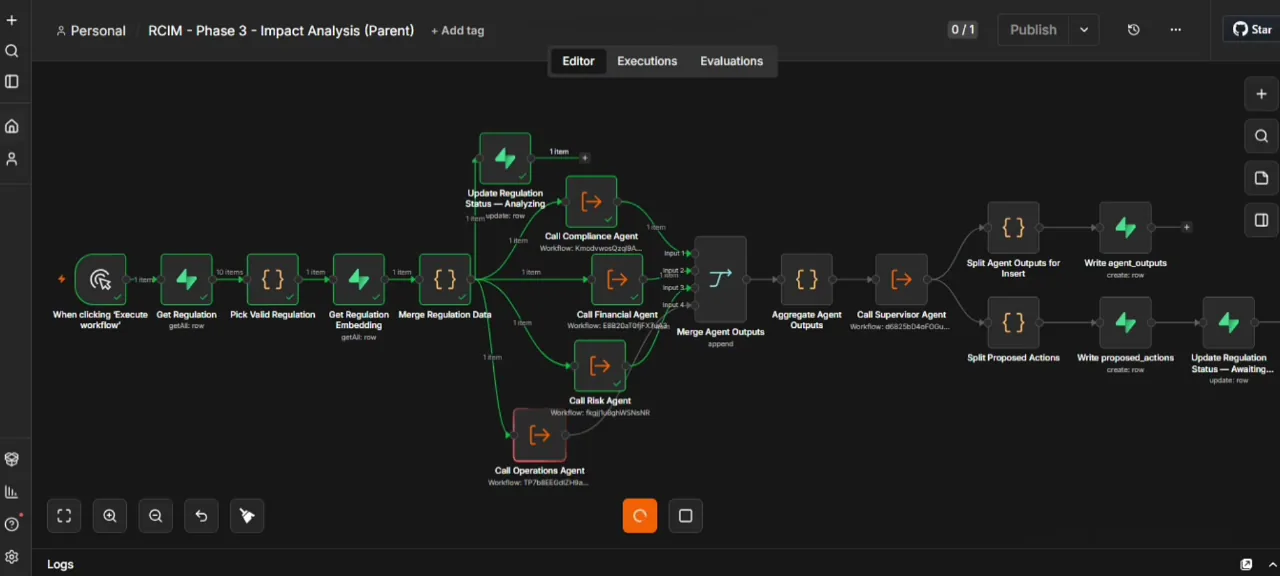
Each stage is its own n8n workflow against a single Postgres source of truth, which is what makes the pipeline debuggable: any phase can be run, inspected and re-run on real data without the others. The multi-agent layer is a parent workflow that fans out to four specialist sub-workflows and collects their outputs — so a specialist can be changed, or a fifth added, without touching the orchestration around it.
- n8n orchestrates every stage as separate, independently runnable workflows
- Supabase (PostgreSQL with vector search) as the single source of truth — regulations, embeddings, agent outputs, proposed actions, approvals, execution log and past decisions
- Deduplication on ingest, so a filing seen once is never analysed twice
- A parent workflow fans out to four specialist agent sub-workflows and merges their outputs for the Supervisor
- Disagreement between specialists is surfaced explicitly rather than silently averaged away
- Every proposed action stays traceable back to the specialist finding that produced it
- Retrieved precedent is passed into the agents, which are instructed to weigh what is genuinely comparable and disregard what is not
- ClickUp queues for task routing, Gmail and Google Calendar for notification, escalation and deadlines
- A dedicated end-to-end integration testing phase, run on live data across every handoff between stages
Technologies
- Multi-Agent AI
- n8n
- OpenAI
- Supabase (pgvector)
- Human-in-the-Loop
- Vector Search
- ClickUp API
- Retool
- Gmail & Calendar APIs
Key results
- Delivered in eight phases and verified running end to end on real data — from a filing appearing at the source through to a completed, logged, precedent-generating action
- Over 300 real federal filings ingested and tracked through the full lifecycle, deduplicated on ingest — the dashboard in the recording above shows 309
- Every regulation receives the same four-perspective assessment, whether it is the first of the week or the fortieth
- Nothing reaches the real world without a person approving it, and every approve, modify and reject decision is recorded for audit
- Overdue actions escalate by email automatically, exactly once, instead of waiting for someone to notice
- Closed-out regulations become precedent that is retrieved and weighed the next time a topically similar filing arrives
- Integration testing across stage handoffs caught four cross-phase defects — including precedent being retrieved but not passed to the agents — that phase-by-phase testing would not have surfaced
Why it matters
The tempting version of this system lets the model decide. This one deliberately does not. Its job is to remove the reading and the triage so that the person making the call spends their attention on the handful of filings that might matter rather than the hundreds that do not. The recorded demo makes that point better than a claim would: a Coast Guard security zone on the Ohio River is assessed by all four specialists — none of whom find any exposure for a financial-services firm with no maritime operations — reaches a Low-severity verdict with three light-touch proposed actions, and the human reviewer rejects all three as unnecessary. Surfacing it was correct and closing it was correct, and both halves of that are the design working as intended.
Services behind this project
Agentic AI & Multi-Agent Systems
Specialist agents, supervisor synthesis and traceable recommendations
Workflow & Process Automation
Ingestion, execution, escalation and monitoring pipelines in n8n
RAG & LLM Integrations
Semantic retrieval against internal policy, contracts and precedent